Deus Rex finds 150+ zero-days in open-source software in under three days

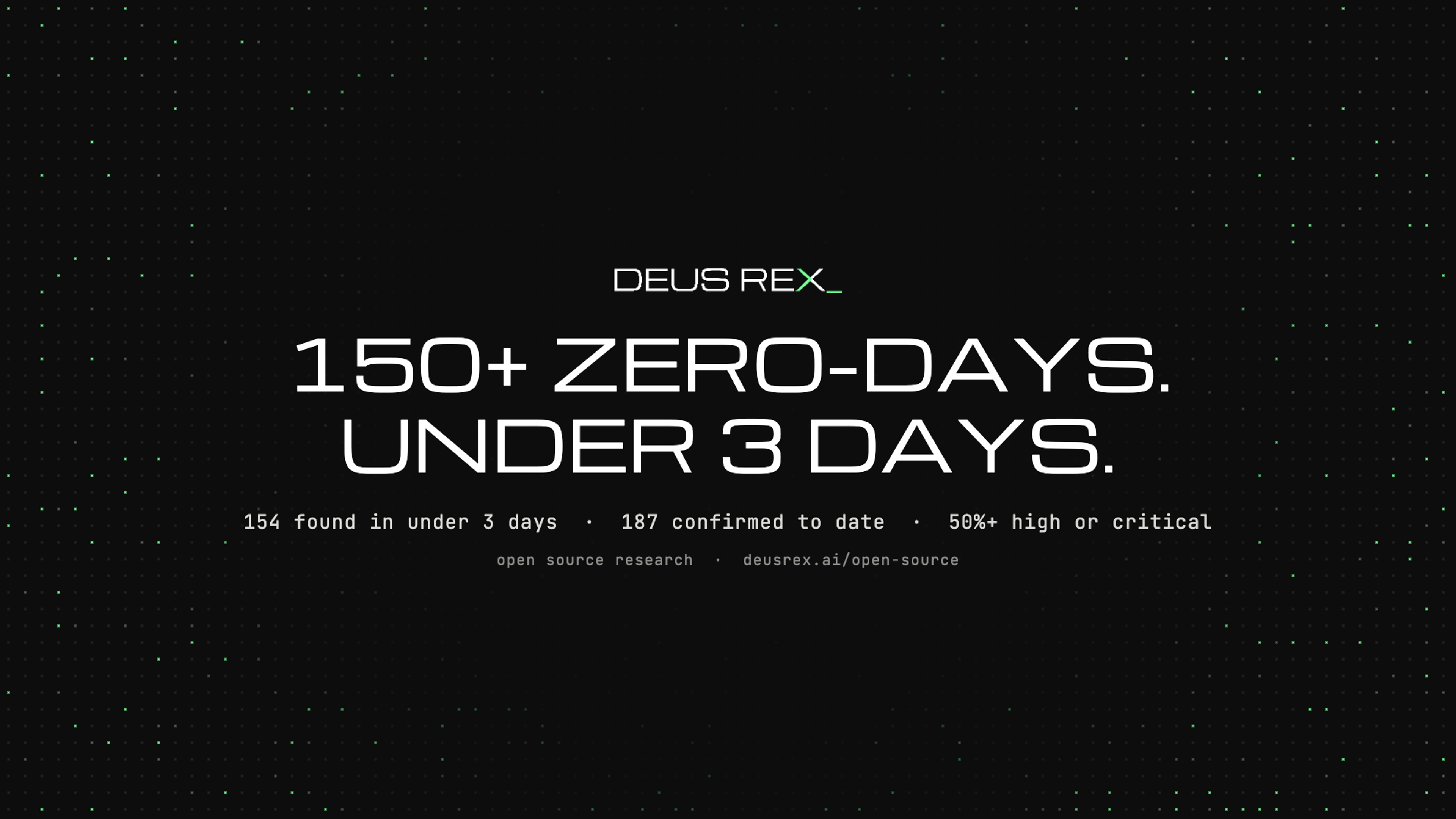
Using small, fast AI models on consumer hardware, the Deus Rex research team found more than 150 zero-day vulnerabilities in widely used open-source software in under three days.
Using small, fast AI models on consumer hardware, the Deus Rex research team found more than 150 zero-day vulnerabilities in widely used open-source software in under three days. More than half are rated high or critical. Every finding has since been reproduced and reviewed: 187 are now confirmed and responsibly disclosed, with more under review.
In October, our research team pointed its vulnerability-hunting system at open-source code written in C and C++, the code that sits underneath much of today's software. In under three days after the system was scaled up, it found 154 zero-days, every one of them a memory safety flaw.
A zero-day is a vulnerability the maintainers didn’t know about, with no fix available when it was found. Until it is reported, nobody can patch it. Memory safety vulnerabilities are mistakes in how a program handles the computer's memory. They are among the most serious security flaws, because an attacker can often use one to crash a program, read data they shouldn't see, or take control of it. That severity is why we pointed the system at this class of flaw first.
The system kept running after those first three days, and a finding only counts once it has been reproduced and reviewed. Today 187 zero-days are confirmed, more than half of them rated high or critical, and more are still under review.
We have reported every one privately to the maintainers of the affected projects, and we are working with them on fixes. We will share details on individual findings once those fixes are available.
Small models, well organised
Most AI security research relies on the largest, most expensive models available. We took a different route: small, fast AI models working inside a well-designed system.
These small models are decision models. They make one quick, focused judgement at a time, which keeps them fast and cheap to run. In Deus Rex, a decision model narrows down where to look. Stronger AI models then examine only those places, work out which problems are real, and prove them. Deus Rex does this autonomously, and a person signs off before anything is disclosed.
In under three days, running on consumer hardware, the system covered more than 4,000 open-source repositories.
Three choices set the approach apart:
- It starts where real bugs hide. That means a security fix applied in one place but missed in its twin, or a widely shipped project that rarely gets tested this way.
- It ranks, it never discards. The decision model puts the likeliest problems first without silently throwing any away.
- It requires proof. Nothing counts as a finding until it has been reproduced.
What it means for open-source security
Serious zero-days can be found earlier and at scale, without frontier models. When a small model does the searching and stronger models are saved for proof, this work comes within reach of defenders and maintainers, not only the largest labs.
Early discovery matters most in shared building blocks. Thousands of products are built on the same open-source libraries, so one flaw can reach all of them at once. The projects we examined are baked into operating systems and commercial software that millions of people use every day. Two recent public cases, neither among our findings, show how far that goes:
- libheif reads the HEIF photo format used by many modern phones. This year, security researchers showed that a flaw in it let a single uploaded photo take over the server behind a major AI company's community forum. Chained with a separate sign-in flaw, it opened a path to internal systems. The researchers disclosed it responsibly, and the forum software, the image toolkit sharp and other projects that bundle libheif all shipped fixes.
- Brotli is the compression browsers and web servers use to make pages smaller. In October, a flaw in its decoder, known as HTTP2Shell, led to coordinated fixes across Node.js, Microsoft .NET, popular Python libraries and Brotli itself. US authorities have since confirmed that attackers are exploiting it.
A fix in one shared library protects every product built on it. That is why we focus on code that is widely shipped but rarely tested. In one set of widely shipped projects we examined, fewer than one in two hundred was part of OSS-Fuzz, Google's free automated testing programme for open source. Those untested projects are where our hit rate was highest.
What you can do:
- Software makers: track the open-source components inside your products, and update them when fixes land.
- Maintainers: responsible disclosure works. We report privately and give you time to fix before anything is published.
- Everyone: install updates. Many of these fixes arrive quietly inside updates to apps and devices you already use.
"Under three days, more than 150 zero-days, on hardware you can order online. The method matters more than the size of the model. We've disclosed everything responsibly, and our goal now is to help open-source maintainers find the next ones before attackers do."
Tim de Wachter, CTO and co-founder, Deus Rex
What's next
As fixes are released, and with each maintainer's agreement, we will publish details on individual findings, followed by a full technical write-up.
Maintain an open-source project? Deus Rex is free for open source (opens in a new tab). Selected projects get a full autonomous scan, verified findings and fixes raised as pull requests. Every finding stays private until you have fixed it. Submit your repository (opens in a new tab).
About Deus Rex. Deus Rex finds security vulnerabilities, proves they are real, and delivers fixes as pull requests that development teams can review and merge. It is built by Cyrex, which has spent more than a decade running offensive security engagements. deusrex.ai (opens in a new tab)
Sources
- libheif: Discourse advisory GHSA-vhm9-85gw-x335 (CVE-2026-32882, July 2026); Hacktron research write-up (opens in a new tab); VentureBeat, 17 September 2026; sharp advisory GHSA-rgj7-g3m4-5g8c / CVE-2026-114112 (October 2026).
- Brotli: CVE-2026-111497 (NVD); Node.js October 2026 security releases; Microsoft .NET security advisory (dotnet/announcements #494); BleepingComputer, 26 October 2026 (opens in a new tab); BleepingComputer on CISA exploitation warning (opens in a new tab).